No, you will not be cracking open a Coca-Cola or grabbing a Big Mac in GTA VI. Take-Two CEO Strauss Zelnick shut the door in late April 2026: inside the game’s world, “all the brands are made up.” It’s a clean promise, but a narrower one than it sounds, and Rockstar’s own history tells you exactly where the licensing money goes.
Take-Two rules out brand partnerships in GTA VI
The comment came on April 28, 2026, on stage at the iicon conference at the Fontainebleau in Las Vegas, as reported by Variety. Asked about possible commercial tie-ins, Zelnick said Take-Two has to stay true to its intellectual property and its players: “It’s a fictional world and everything in it is fictional. So we’re not even at risk of doing brand partnerships, because all the brands are made up. And I think that’s what keeps us pure.”
It’s the only 2026 statement that names GTA VI directly. It’s unequivocal on product placement, and it lines up with nearly thirty years of in-house writing: from Cluckin’ Bell to Lifeinvader, skewering American brands is a pillar of the series, not set dressing.
The promise is about intrusive ad breaks, not all advertising
A month earlier, on March 17, 2026, the same Zelnick struck a more nuanced note talking to Christopher Dring for The Game Business. His exact words: “Very hard for me to believe that we would want interstitial advertising in a game that someone paid $70 or $80 for. That would seem unfair.”
Three qualifiers matter, and they get dropped in almost every pickup: he was talking about interstitial advertising, meaning the kind that interrupts play; he explicitly contrasted premium with free-to-play (“for free-to-play titles, yes”); and he never named GTA VI in that answer. He even cited an in-house counterexample, NBA 2K, where courtside signage from real brands “matches the language” of the simulation.
So Take-Two is hardly an anti-advertising publisher. In the fiscal year that ended March 31, 2026, the company reported $494.3 million in advertising revenue against $6.656 billion in net bookings, roughly 7.4% of the business and up 6% year over year. Most of it comes from mobile and Zynga. Zoom out to the wider market and in-game advertising is still a rounding error, 2.3% of expected digital ad spending in 2026 according to eMarketer, but it’s growing. Rockstar’s firewall is specific to GTA. It isn’t doctrine at the publisher level.
Saying no to real brands is a creative call, not a lack of offers
You hear the argument all the time from players: Rockstar is leaving millions on the table out of squeamishness. Take-Two answered that one back in 2022, speaking to GamesIndustry.biz, when asked why GTA Online hosted so few collaborations. The answer took two sentences: “It’s really a creative decision driven by the Rockstar team. It’s not a financial decision.” With the same carve-out as today: the NBA and the PGA Tour play nice with brands, GTA does not.
Nothing would stop them technically. Take-Two signed a dynamic in-game advertising deal with ad network Double Fusion as far back as December 2006, but it only covered the 2K Sports and 2K Games franchises. There’s no documented case of an ad network being wired into a Rockstar game, not in the GTA IV era, not since.
U.S. courts protect Rockstar’s fake brands
There’s a deeper reason, and it’s case law. On November 5, 2008, the Ninth Circuit Court of Appeals decided E.S.S. Entertainment 2000 v. Rock Star Videos: the operator of the Play Pen strip club in Los Angeles had sued Rockstar over the Pig Pen in East Los Santos, in San Andreas.
The court extended the Rogers v. Grimaldi test, until then limited to the titles of works, to the content of a work itself: “there is no principled reason why it ought not also apply to the use of a trademark in the body of the work.” All it takes is artistic relevance above zero and a use that doesn’t explicitly mislead the public. Judge O’Scannlain even ran with the metaphor: fans might spend all nine innings at a ballpark’s hot dog stand, and that still doesn’t make Dodger Stadium a butcher shop. Rockstar won.
Same logic in March 2018, when a New York State appeals court threw out Lindsay Lohan’s suit: in its view, the GTA V character was merely a “generic artistic depiction” of a twentysomething woman, falling under “cultural commentary.” Rockstar’s satire is well covered, then. The studio isn’t avoiding real brands out of fear of a lawsuit. It skips them because its city only works if everything in it is fake.
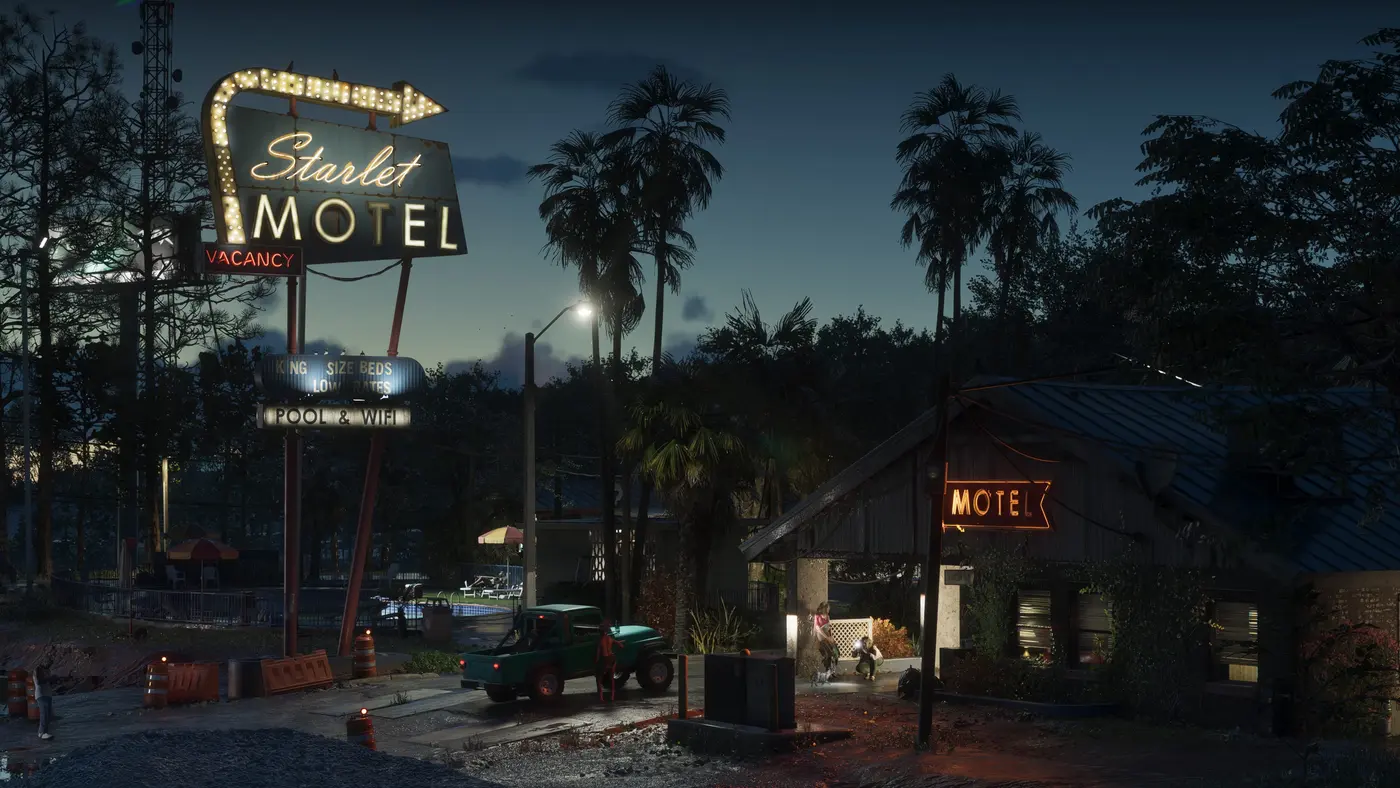
Leonida’s brands are already all over the official material
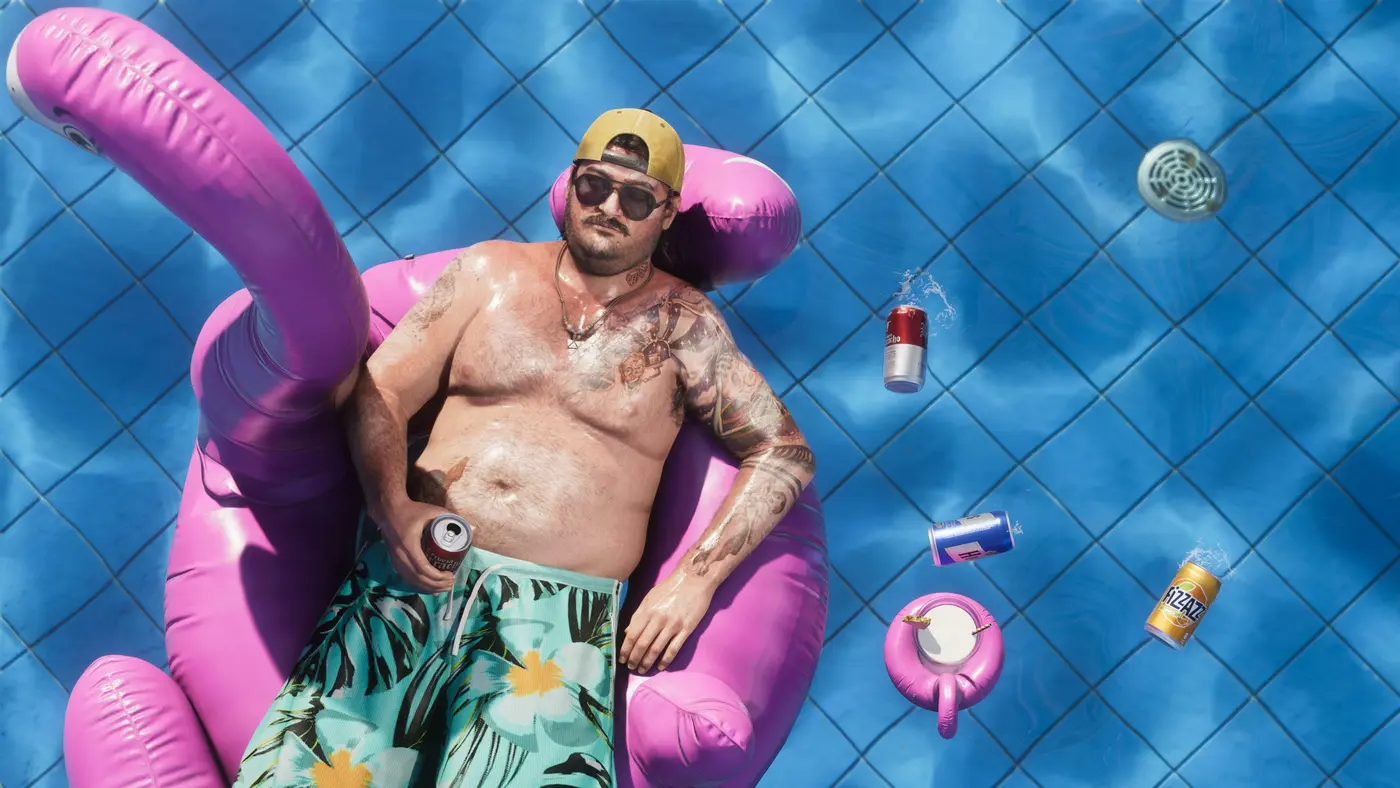
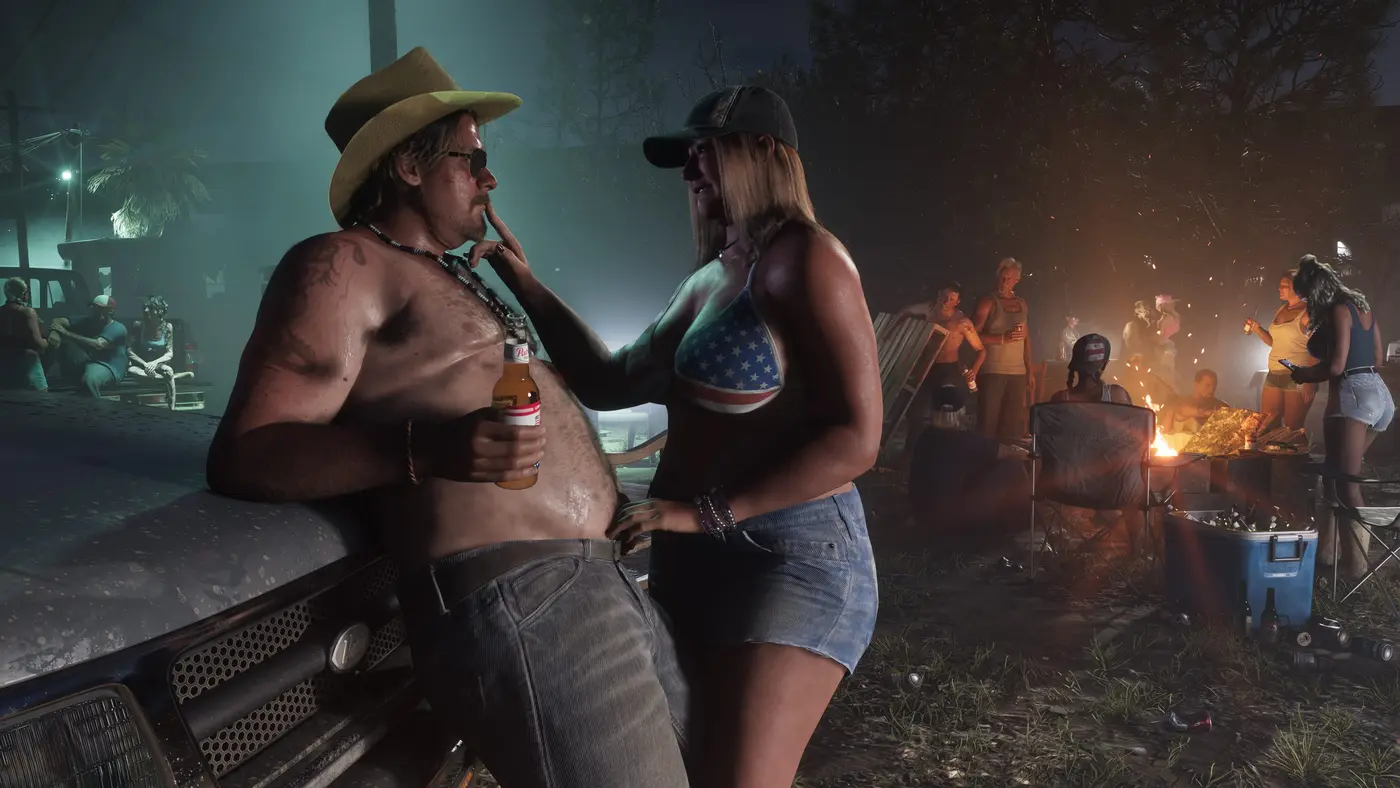
The funny part is that Rockstar is already running ads for GTA VI, just for brands that don’t exist. The second trailer includes a TV spot for Phil’s Ammu-Nation, pitched by a gun dealer whose name, look and role lift straight from Phil Cassidy of the 3D-era GTA games, and, inside a convenience store, a pack of FizzAzz bottles sitting on an ATM, a parody soda whose logo riffs on Fanta’s. The same orange can turns up floating in the pool at Cal Hampton, in a screenshot from the official site.
Video Games Chronicle’s frame-by-frame breakdown of the first trailer had already flagged Patriot Beer, Pisswasser, Weazel News, luxury house Sessanta Nove and delivery service Go Postal. The canon runs deep and stays consistent, and the real-world models are still easy to read:
| GTA brand | Sector | Real-world model |
|---|---|---|
| Sprunk | Soda | Sprite |
| 24/7 | Convenience store | 7-Eleven |
| Cluckin’ Bell | Fast food | KFC |
| Taco Bomb | Fast food | Taco Bell |
| Up-n-Atom | Fast food | In-N-Out Burger |
| Lifeinvader | Social network | |
| Weazel News | News network | Fox News |
Where Rockstar really does pay for rights: the music
The contrast is striking. Not one licensed soda brand, but a soundtrack that costs a fortune: for GTA V, music supervisor Ivan Pavlovich explained on a panel covered by Polygon that the team aimed for 900 tracks before settling on 241 licensed songs, spread across 17 radio stations.
Those deals have a shelf life, and that’s where the model starts to strain. In April 2018, Rockstar had to gut GTA IV’s radio stations, the Russian Vladivostok FM in particular, with a blunt statement: “due to music licensing restrictions, we are required to remove certain songs.” David Bowie and the Smashing Pumpkins went out with the cuts. Worse, in November 2012, Vice City was pulled from sale on Steam entirely while a Michael Jackson track whose rights sit with Sony Music got sorted out.
An invented brand, by contrast, costs nothing and never expires. That’s a preservation argument too: Sprunk will still be there in ten years, the playlist maybe not.
The exceptions exist, and the door is still ajar
Saying Rockstar has never let a real brand in would be wrong. In December 2020, GTA Online’s Cayo Perico update added two real fashion labels, Berlin’s Civilist and Poland’s MISBHV, announced on the official Newswire. Two years before that, After Hours brought in real DJs, Solomun and Tale Of Us chief among them. Over at Rockstar San Diego, Midnight Club 3 was already running licensed cars back in 2005.
That leaves the genuine gray area, and Zelnick drew its border himself: his promise covers games sold for $70 or $80. If the next GTA Online, the one built on GTA VI, went free-to-play, the unfairness argument would evaporate on its own. Nothing has been announced there, and that’s exactly what to watch after November 19, 2026, once Grand Theft Auto VI shifts from selling a game to running a service.
As for the rest of the scenery, you can relax: the Leonida you’ll be driving through on November 19 will be full of sodas, gun stores and news networks that never existed. That’s exactly what has kept the satire standing since 1997.
Read next: our breakdown of the real-life references behind Vice City, our take on how much GTA VI will cost and the map of the state of Leonida.
Comments
Be the first to react.