
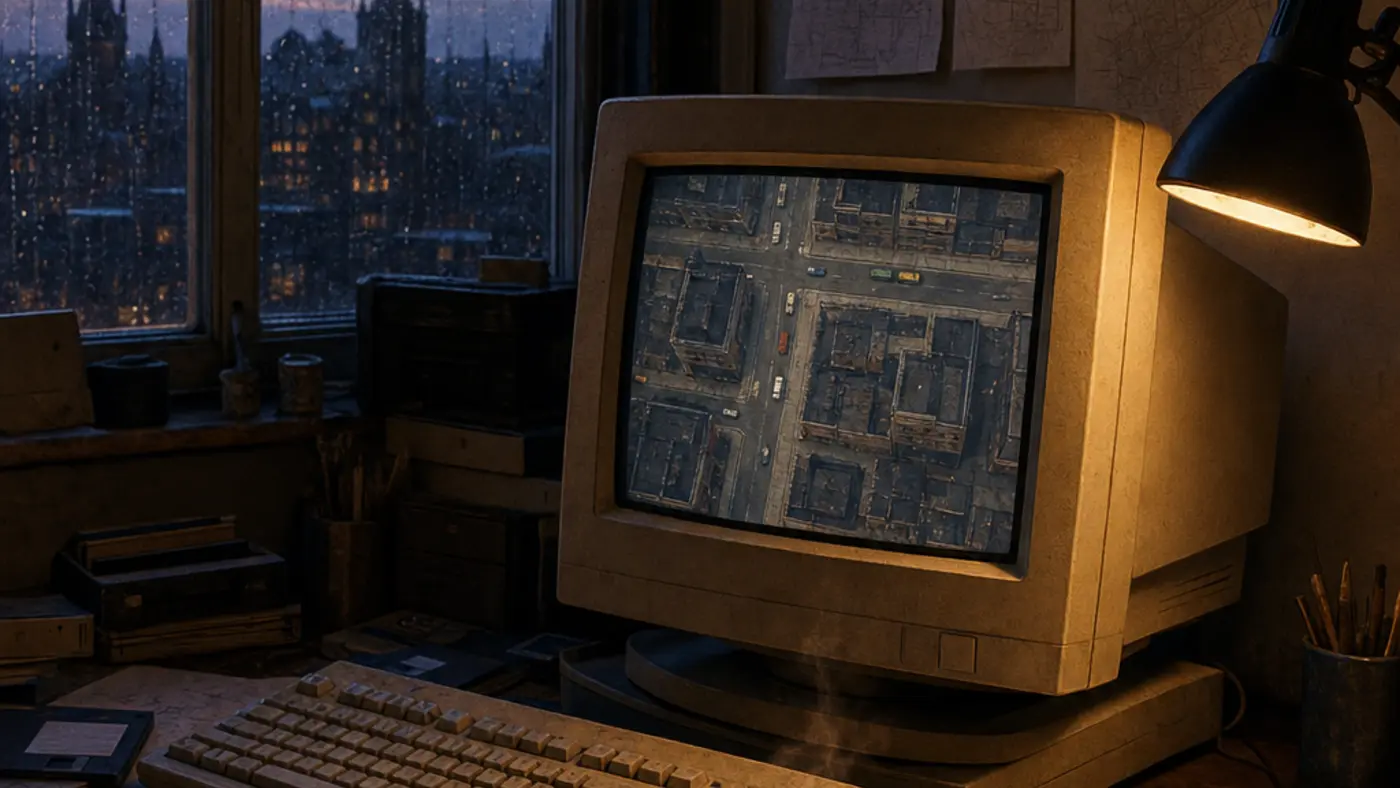
It’s easy to picture Grand Theft Auto being born in a glass tower in Manhattan. The reality is humbler: gaming’s most profitable saga got its start in Dundee, an industrial city in Scotland, at a studio called DMA Design. Here’s how an ordinary top-down racing project became, almost by accident, a global phenomenon.
It All Started in Dundee, Not New York
DMA Design was founded in 1988 by David Jones, a former worker at Dundee’s Timex factory who bought an Amiga with his severance pay. The studio blew up in 1991 with Lemmings, a cult puzzle game that sold around twenty million copies across some twenty platforms. That success bankrolled the experiments that followed, including a certain car game. So before it was a criminal empire, GTA was the child of a group of friends who met at an amateur computer club, a world away from the American industry.

Race’n’Chase, the Prototype Going Nowhere
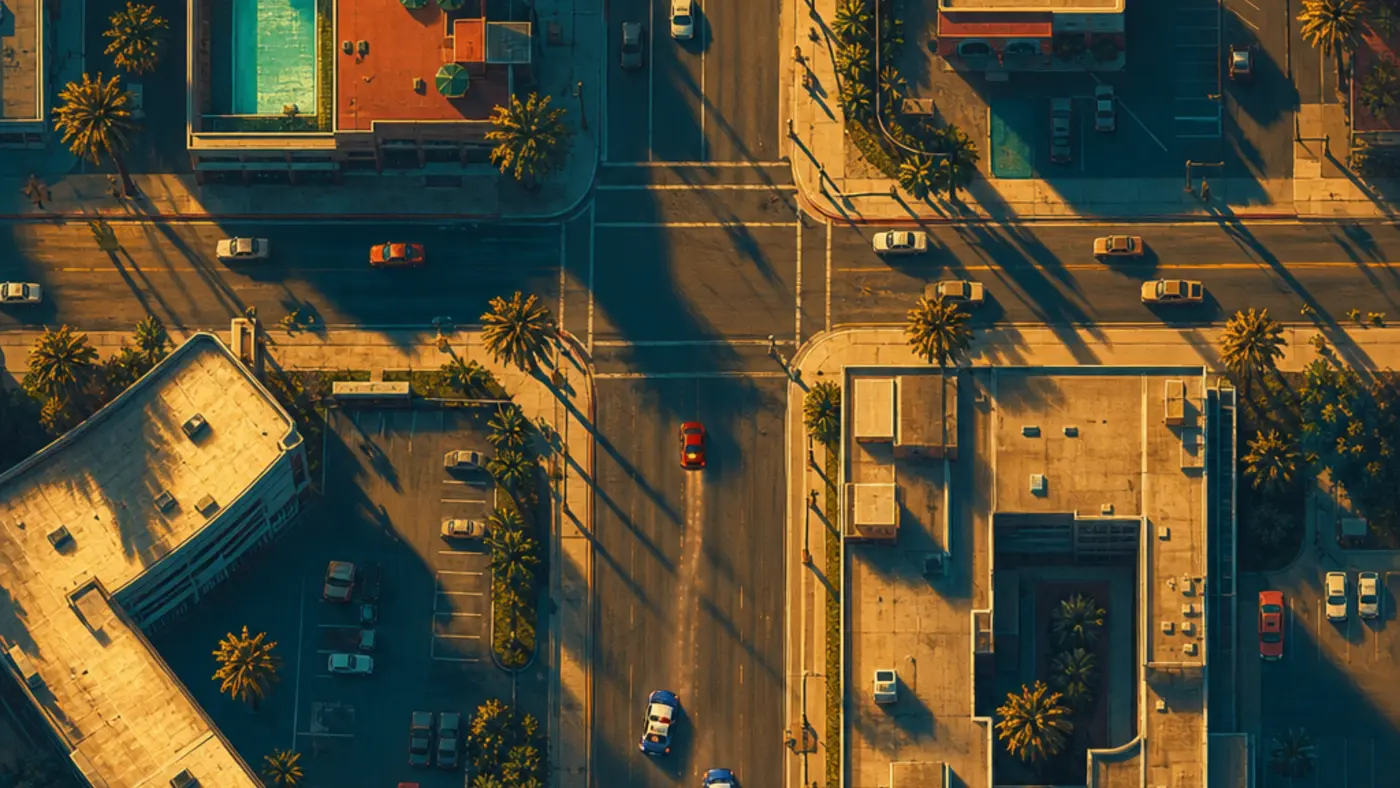
Development kicked off in March 1995. The project was called Race’n’Chase back then and ran on programmer Mike Dailly’s top-down “Legovision” engine: a bird’s-eye view, three cities inspired by real American metropolises (Liberty City, San Andreas, Vice City), and modes blending racing, demolition derby, and heists where you picked your side, cop or robber. The team quickly leaned toward the robber, which was more fun, and renamed the whole thing Grand Theft Auto.
Except nothing was a sure thing. “It was a mess,” says Gary Penn bluntly, who came over from publisher BMG to the project and remembers being “pretty much the only one trying to keep it alive.” Worse: GTA wasn’t even the studio’s star. “It wasn’t the company’s golden child,” recalls designer Steve Hammond. “The one everybody cared about was Body Harvest.” At that point, GTA was just one of eight or twelve projects running in parallel.
The Police Bug: Legend or Reality?
It’s the most-told story in all of gaming history: a bug supposedly made the police cars suddenly go hysterical, charging in to ram the player, and that accidental aggression supposedly turned a boring game into an exhilarating chase. PC Gamer quotes Gary Penn, who said the police “went psycho and aggressive” overnight.
The truth is more nuanced, and that’s what makes it interesting. DMA veterans insist there was no single turning point. The project had just one weapon, no health bar (one bullet and you were done), and rested on a rigid progression. It was a complete overhaul of the driving, the addition of the in-car radio, and the switch to an arcade-style points system that, together, made GTA addictive. The myth of the game-saving bug is prettier than the reality of long hours of fine-tuning.
1997: The Scandal That Sold It All
Grand Theft Auto launched on PC on November 28, 1997, published by BMG Interactive, then on PlayStation. To roll it out, BMG hired the firm of notorious PR man Max Clifford, a believer in “all publicity is good publicity.” His method: play up the game’s violence to provoke the press. The British tabloids took the bait, politicians called for a ban (Lord Campbell of Croy was the first, denouncing it as “vile filth”), and DMA’s communications chief, Brian Baglow, ended up splashed across a full page of a Sunday paper, recast as a reckless driver.
The game wasn’t banned, and the scandal did exactly what Clifford promised: it drew attention. GTA became a cult hit, passed around behind parents’ backs, and sold roughly 500,000 copies for some £25 million in revenue. The “provoke to sell” playbook would go on to become a company signature.
From BMG to Rockstar: How the Franchise Changed Hands
The business side gets complicated. DMA Design was bought by Gremlin Interactive in April 1997 for £4.2 million, just before the game’s release. Then, in March 1998, BMG sold its entire interactive division to Take-Two for $9 million. The deal sent Sam and Dan Houser, Jamie King, and a few others off to New York, where they built Take-Two’s American label: Rockstar Games.
All that was left was to put the pieces together. Take-Two finally bought developer DMA Design from Infogrames in September 1999, for a symbolic one pound and the assumption of $12.3 million in debt. The Scottish studio was merged into Rockstar, renamed Rockstar Studios and then Rockstar North in 2002, the year GTA went 3D and changed dimensions for good.
| Year | Milestone | Source |
|---|---|---|
| 1988 | David Jones founds DMA Design in Dundee | Wikipedia (Rockstar North) |
| 1991 | Lemmings, around 20 million copies | Wikipedia (Rockstar North) |
| March 1995 | Race’n’Chase project begins, the future GTA | Film Stories |
| April 1997 | Gremlin buys DMA for £4.2M | Wikipedia (Rockstar North) |
| Nov. 28, 1997 | GTA released on PC, published by BMG | Wikipedia (GTA, 1997) |
| March 1998 | BMG sells its division to Take-Two ($9M) | Film Stories |
| Sept. 1999 | Take-Two buys DMA from Infogrames | Wikipedia (Rockstar North) |
| 2002 | DMA Design becomes Rockstar North | Wikipedia (Rockstar North) |
What Dundee Passed Down to GTA 6
Nearly thirty years later, the DNA laid down in Dundee hasn’t shifted an inch: an open world, total freedom, a biting satire of America, and those police chases that were already the whole appeal of Race’n’Chase. The three cities of the 1997 game have grown into entire worlds, from Liberty City to the Vice City being reborn in GTA VI. When you boot up Grand Theft Auto VI, on November 19, 2026, you’re really playing the same brilliant idea that was born on a Scottish cathode-ray screen.

Comments
Be the first to react.